
Match seasonal wind with the right reef and water depth
Best Time to Surf Nusa Dua: Wet Season, Wind, Tide and Swell
Nusa Dua is best known as a wet-season surf area, but there is no single best tide or hour for its many reefs. The useful window depends on wind direction, swell energy, reef depth, current and the surfer’s ability.
Local insight from Hendra Surf School · Approximately 10 minutes
Why wet season matters
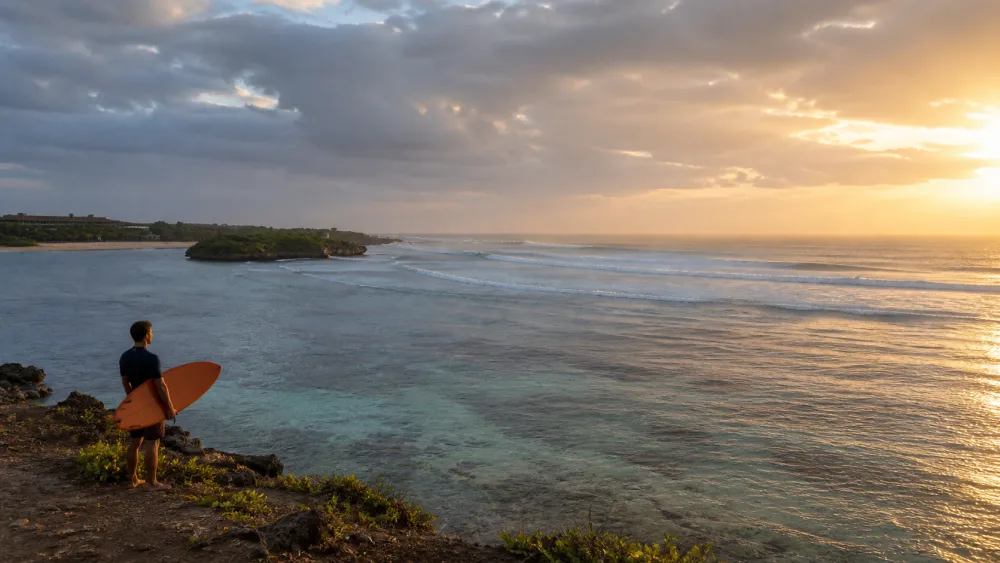
Nusa Dua faces the east and southeast, so west and northwest winds common from about November through March can arrive offshore or cross-offshore at several reefs. That is why Nusa Dua surf coaching is especially relevant when Bali’s west coast is wind-affected.
Wet season does not mean every break is clean all day. Local showers, squalls and southwest wind angles can favour one peak while making another choppy. The coast provides options, not certainty.
| Wet season | More frequent offshore/cross-offshore wind on the east coast. |
|---|---|
| Dry season | East/southeast trade wind can be less favourable; early calm windows may exist. |
| Tide | Controls coral depth and whether each specific peak breaks. |
| Swell | Direction and period affect size, power and current differently across reefs. |
| Best confirmation | Short-range forecast plus an on-site check of the chosen zone. |
Wind direction by break
Black Stone and Mengiat can respond differently from Mushroom Rock because low islets and headlands provide partial shelter. A crosswind on one side may leave the neighbouring wave cleaner. This is why local observation can outperform a general Nusa Dua wind arrow.
Strong offshore wind is not automatically easy. It can hold up a small wave, spray into the surfer’s vision and make a large board difficult to control. Beginners generally benefit from light, organised conditions.
Tide is reef-specific
Black Stone
The shifting peak commonly needs a mid-tide type window. Low water can create close-outs and shallow coral, while too much water on a small swell may stop the wave breaking effectively.
Mushroom Rock
The fast right generally needs higher water to become rideable. At lower tide it can be too shallow and rapid; larger swell can still make it advanced or expert-only.
Protected inside reforms
A learner zone needs enough water for safe falls, but too much depth may weaken the whitewater. The coach matches the inside to set size rather than copying the main peak’s tide rule.
Swell size, direction and period
South, south-southwest and southwest swell can activate different parts of the reef. Height describes only one dimension. Longer period means more energy, stronger sets and potentially more current even when a forecast face looks moderate.
Black Stone may become difficult when swell grows or period lengthens because the take-off bounce and current increase. Mushroom Rock becomes heavier on larger arrivals. Outer Nusa Dua reefs can hold more size but demand advanced judgement.
Morning, rain and lightning
Morning is often useful because local wind may be lighter and the east coast receives sunrise light, but a favourable tide later can matter more. The correct time is the overlap of wind, water depth and objective.
Short tropical rain does not automatically cancel a session. Lightning, low visibility, strong squalls and runoff are different: they require delay, relocation or cancellation.
Best window by level
Complete beginner
Choose a protected reform with adequate depth, low current and enough space. The most photogenic outside peak is irrelevant.
Developing beginner
A soft inside green wave can support angled take-offs when the return route remains simple.
Intermediate
Use a controlled shoulder or smaller reef peak that provides repeatable take-offs without exceeding paddling or reef confidence.
Advanced
Larger outer peaks can be appropriate, but tide, channel, crowd and exit still need a fresh check.
Practical booking sequence
- Share your real level and preferred date.
- Check the wet-season wind pattern several days ahead.
- Select the exact break only after comparing swell and tide.
- Reconfirm lightning, visibility and current close to the session.
- Move to Jimbaran or another coast when Nusa Dua loses the useful window.
Nusa Dua Surf FAQs
What months are best for Nusa Dua?
November through March commonly brings more favourable west or northwest wind, although daily conditions vary.
Is high tide always best?
No. Mushroom Rock often needs higher water, while Black Stone and inside reforms have different depth requirements.
Does morning guarantee clean surf?
No. Morning can bring lighter wind, but tide, squalls and swell arrival may favour another time.
How does swell period matter?
Longer period adds energy and can increase wave power and current beyond what height alone suggests.
Can beginners surf during wet season?
Yes at selected protected inside zones with suitable depth, wind and current.
What if the wind changes?
A neighbouring reef, different time or another coast may become the better option.
Ask Hendra Which Nusa Dua Reef Fits Today
Share your level, group size and date. Hendra will check tide, swell, wind, current, weather and a suitable reef zone before confirming.